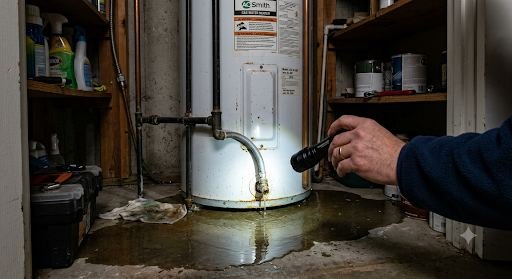
Water Heater Leaking: Is It an Emergency?
Quick Facts
- Is this an emergency?
- Depends on location — bottom leaks are more serious
- First step
- Shut off water supply and power/gas to the unit
- Typical unit lifespan
- 8–12 years
- Can you DIY it?
- Shutoff only — not a DIY repair
A leaking water heater ranges from a minor, same-week fix to a genuine emergency, and the difference mostly comes down to one thing: where exactly the water is coming from. A tank holds 40 to 80 gallons under pressure, and if it fails completely rather than just seeping from a fitting, that entire volume can end up on your floor in minutes.
Shut Off the Water and Power First
Locate the cold-water shutoff valve on the pipe entering the top of the tank and turn it clockwise to close it. Then cut power to the unit — flip the breaker for an electric water heater, or turn the gas control valve to "off" for a gas unit. Doing both before anything else limits the damage regardless of what turns out to be causing the leak.
Leaking From the Top: Usually a Connection, Not the Tank
A leak visible at the top of the unit often traces back to a loose fitting, a failing cold-water inlet or hot-water outlet connection, or a faulty temperature and pressure relief (T&P) valve. These are generally repairable without replacing the whole unit, and while still worth addressing promptly, they're a meaningfully different situation than a tank that's actually failing.
Leaking From the Bottom: Often the Tank Itself
Water pooling at the base is more concerning — it frequently means internal corrosion has finally worn through the tank wall itself, which isn't a repairable situation. A worn drain valve can also cause bottom leaking and is a simpler fix, but you can't reliably tell the difference without someone inspecting it directly, which is exactly why this situation calls for a professional visit rather than a guess.
Age Matters More Than It Seems Like It Should
Water heaters typically last 8 to 12 years. If yours is within or past that range and now leaking, replacement is often the more sensible move rather than repairing a unit that's likely to fail again soon regardless of what gets fixed this time. A plumber can give you a straight answer on repair versus replace once they've actually seen the unit and its age.
Why the Volume Involved Makes This Different From a Small Drip Elsewhere
A dripping faucet is an annoyance measured in cups per hour. A failed water heater tank is 40 to 80 gallons released over minutes, not hours — enough to spread across multiple rooms, soak flooring and drywall, and reach electrical components nearby. That volume and speed is exactly why a water heater leak gets treated as more urgent than most other slow plumbing leaks, even though the visible puddle might look similar at first glance.
What Not to Do
Don't attempt to drain or disassemble the tank yourself if you're not confident doing it safely — a tank under pressure with a failing seal can behave unpredictably. Don't wrap a leaking valve or fitting with tape and consider the problem solved; it's a stopgap at best. And don't ignore a small leak hoping it stops on its own — sediment buildup and corrosion generally get worse, not better, over time.
What a Plumber Actually Checks During a Repair Visit
A technician will typically test the T&P valve directly, check every fitting and connection for the actual source rather than assuming based on where water pooled, inspect the tank itself for signs of corrosion or a through-wall failure, and check the anode rod — a sacrificial metal rod that corrodes in place of the tank itself, and one of the more overlooked maintenance items on a standard water heater. A worn-out anode rod is a common contributor to tanks failing earlier than their typical lifespan.
Maintenance That Extends the Life of the Next One
Annual tank flushing clears sediment buildup that otherwise insulates the bottom of the tank from the heating element and accelerates corrosion. Checking the anode rod every few years and replacing it once it's significantly corroded is inexpensive compared to the tank failure it helps prevent. Neither of these fully eliminates the risk of an eventual leak, but both meaningfully extend how long you get before facing this situation again.
When to Call Immediately vs. When It Can Wait
Active flooding, a leak from a worn drain valve gushing steadily, or any water near electrical components at the unit calls for an immediate emergency call. A slow drip from a single fitting that a small pan handles fine overnight is still worth a same-day or next-day call, but it's a meaningfully lower-urgency situation than the others.
Sources: Anderson Plumbing, Heating & Air, United Water Restoration Group.
| Leak location | Likely cause | Call a plumber? |
|---|---|---|
| Top of tank | Loose fitting, T&P valve, inlet/outlet connection | Yes — same day |
| Bottom of tank | Internal corrosion (tank) or worn drain valve | Yes — immediately, needs inspection to tell which |
| Steady gush, any location | Active tank or valve failure | Yes — immediately |
This guide can help you read where a leak is coming from, but it can't tell you whether your specific tank has failed internally or just needs a valve replaced — that distinction genuinely requires a plumber's inspection, not a guess from an article.
Frequently Asked Questions
Is a leaking water heater always an emergency?
Not always — a small drip from a fitting is worth addressing promptly but isn't the same urgency as active flooding or a failing tank. Location of the leak is the key signal.
Can I keep using hot water while it's leaking?
For a minor, contained drip, often yes in the short term — but easing up on hot water use and getting it looked at soon is the safer approach, especially if the cause is unconfirmed.
How much does water heater repair or replacement cost?
It varies by whether it's a valve/fitting repair or a full replacement, plus your unit's size and fuel type. See our cost guide for a fuller breakdown.
Why does the age of my water heater matter if it's just a small leak?
A unit already near or past its typical 8–12 year lifespan is more likely to have additional issues developing, so a small leak now is often a sign replacement is the more sensible move rather than repeated repairs.
Should I turn off the gas or just the water?
Both. Shutting off the water stops the leak from getting worse; shutting off gas or electric power to the unit removes a separate risk, especially if water is anywhere near electrical components.