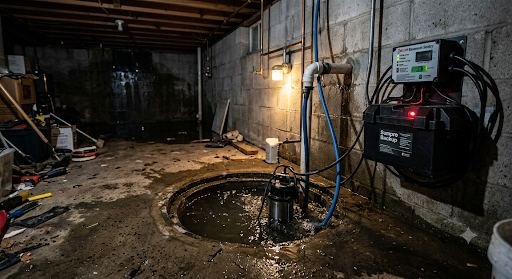
Sump Pump Failure During a Storm: What to Do
Quick Facts
- Is this an emergency?
- Yes, if water is actively rising
- First step
- Cut power safely, never wade into water with power on
- Manageable vs. major flooding
- About 2 inches of standing water is the rough line
- Can you DIY it?
- Temporary stopgap yes — permanent fix usually needs a pro
A sump pump quietly does one job: keep groundwater out of your basement. When it fails during a storm, that job doesn't pause just because the pump did — water keeps rising, and how you respond in the next few minutes affects how much damage you're dealing with by morning.
Safety Before Anything Else
Never step into standing water if you can't confirm power is off to that area — a submerged outlet or appliance is a real electrocution risk. If you can reach your electrical panel without walking through water, shut off the circuit for the affected area. If you can't reach it safely, unplug what you can reach instead and leave the rest until the water recedes or a professional can assess it.
Identify Why It Failed
The most common culprits are a power outage (especially without a battery backup), a stuck or tangled float switch that never triggers the pump, a clogged intake screen or discharge line, and less often a worn check valve or a pump simply undersized for how much water is coming in during a major storm. Checking the breaker and the GFCI outlet the pump plugs into takes thirty seconds and resolves a real share of "failures" that are actually just tripped power.
Try a Temporary Fix While You Wait for Help
If the float switch is visibly stuck, you can sometimes free it by hand with power off first. If the pump itself has failed outright, a portable utility pump or a battery-backup sump pump, if you own one, can be set into the pit as a stopgap — run the discharge outside and away from the foundation, the same as the main pump would. A wet-vac emptied outside repeatedly can buy real time even without a spare pump on hand.
Watch the Volume, Not Just the Fact That It's Flooding
Two inches of water or less is generally considered manageable for a homeowner to clean up once the source is addressed. Beyond that, water spreads into more materials faster than it looks like it should, and professional water extraction becomes the more sensible option rather than trying to keep up with towels and a wet-vac.
Don't Send the Overflow Into a Floor Drain
If your sewer system is also under stress during the same storm, water pumped or directed into a floor drain can back up rather than draining away — worth keeping in mind before assuming any drain in the basement is a safe place to route standing water.
Insurance Considerations
Standard homeowners policies frequently exclude sump pump failure and the water damage it causes unless you've specifically added an endorsement for it — this is different from how burst-pipe damage is typically treated. If you haven't checked whether your policy includes this coverage, that's worth confirming before you need it, not after a claim gets denied. Documenting the failure, the cause if you can determine it, and the resulting damage with photos still matters regardless of what your specific policy covers.
Testing Your Pump Before the Next Storm
A quarterly test takes a few minutes: pour enough water into the pit to trigger the float switch and confirm the pump activates, moves water out through the discharge line, and shuts off properly afterward. This catches a stuck float or a pump that's stopped working long before the next major storm puts it to the actual test.
After the Water's Down
Run fans and a dehumidifier to pull remaining moisture out once standing water is largely removed. Materials that stayed wet for an extended period — drywall, carpet padding, insulation — are often more cost-effective to replace than to fully dry and hope mold doesn't take hold, especially in a basement where airflow is naturally limited.
Preventing the Next Failure
A battery backup system is the single highest-value addition, since power loss during a storm is one of the most common failure points precisely when the pump matters most. A water alarm placed near the pit alerts you the moment water rises unexpectedly, rather than you discovering it hours later. And a second pump, even a basic one, removes the single point of failure that one pump alone represents during the exact conditions when failure is most likely.
Sources: Paul Davis Restoration, Total Dry Restoration.
| Cause | Quick check | Temporary fix |
|---|---|---|
| Power outage | Check breaker and GFCI outlet | Portable/battery backup pump |
| Stuck float switch | Look for visible tangling or debris | Free it by hand with power off |
| Clogged discharge line | Check outside end for ice/debris | Clear visible blockage if safe to reach |
| Pump undersized or worn out | Pump runs but can't keep up | Wet-vac to buy time, call for replacement |
This guide covers safe, general steps — it can't tell you whether your specific pump has failed mechanically or is simply overwhelmed by an unusually large storm. If flooding continues despite a working pump, that's a capacity or drainage question for a professional, not a sign you did something wrong.
Frequently Asked Questions
Is it safe to walk into a flooded basement?
Only if you're certain power is off to that area. Standing water near an outlet, appliance, or panel is a genuine electrocution risk — don't guess.
How much water is considered a major flood?
Roughly 2 inches or less is generally manageable for a homeowner to clean up. Beyond that, professional water extraction is usually the more sensible call.
Can I pump water into a floor drain during a storm?
Not if your sewer system is also stressed by the same storm — it can back up rather than drain, making things worse rather than better.
Does a battery backup really make a difference?
Yes — power outages during storms are one of the most common sump pump failure points, and a battery backup addresses exactly that scenario.
Should I replace carpet and drywall that got wet?
If materials stayed wet for an extended period, replacement is often more cost-effective and safer than trying to fully dry them and hope mold doesn't develop, especially in a basement with limited airflow.