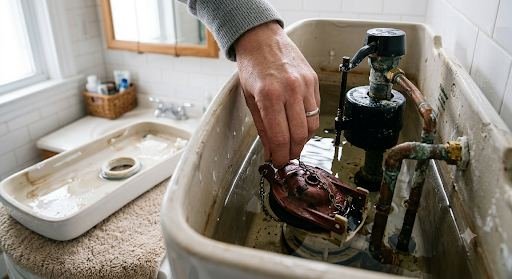
Running Toilet Won't Stop: Quick Fixes vs. When It's a Bigger Problem
Quick Facts
- Is this an emergency?
- No — wastes water, but not urgent
- Most common cause
- Worn or warped flapper
- Diagnostic step
- Pencil-mark the water level, wait 15–20 minutes
- Can you DIY it?
- Yes, in most cases — inexpensive parts, no special tools
A running toilet is one of the few plumbing problems in this series that's rarely an actual emergency — it wastes water and money, but it's not flooding your home or threatening structural damage. That also makes it one of the more approachable DIY fixes, since the parts are inexpensive and the diagnosis is fairly mechanical.
How a Toilet Tank Actually Works
Pressing the handle lifts a flapper, releasing tank water into the bowl and triggering the siphon that pulls waste down the drain. As the tank empties, a float drops, opening the fill valve to refill the tank; once the float rises back to the right level, the fill valve shuts off. A running toilet means water is escaping somewhere in that cycle when it shouldn't be — most often at the flapper, sometimes at the fill valve itself.
The Diagnostic Test That Tells You Where to Look
With the tank full and the toilet not flushed, turn off the water supply at the valve behind the toilet. Mark the water level with a pencil, then wait 15 to 20 minutes. If the level hasn't dropped, the running you heard was likely just the fill valve topping off normally. If it has dropped to right around the flapper, the flapper is your culprit. If it's dropped to a point on the overflow tube instead, the fill valve is the more likely problem.
Fixing a Worn Flapper
This is the most common cause and the easiest fix. Flappers degrade with age, especially with hard water or in-tank cleaning tablets that can make rubber brittle. Turn off the water, remove the old flapper, and bring it to a hardware store to match it exactly — flapper sizes and attachment styles vary. Most flappers snap over ears on the overflow tube or use a ring that slips over it; installation takes a few minutes.
Fixing a Fill Valve or Chain Issue
If the fill valve itself won't shut off even after the tank is full, or the float doesn't rise properly, the fill valve likely needs replacing rather than adjusting. Separately, check the chain connecting the flush lever to the flapper: too much slack and the flapper won't seat fully, too little and it won't lift enough for a complete flush. A properly adjusted chain has just a small amount of slack when the flapper is closed.
Why This One's Worth Fixing Promptly Anyway
Even though it's not an emergency, a running toilet can waste a genuinely significant amount of water over weeks or months, showing up as an unexpectedly high water bill before anyone notices the sound has become background noise. Treating it as a same-week fix rather than an indefinite annoyance is worth it purely on cost grounds.
Silent Leaks Are the Trickier Version
Not every running-toilet leak is audible. A dye test catches the silent ones: add a few drops of food coloring to the tank water, wait about 15 minutes without flushing, and check the bowl. If color has appeared in the bowl, water is leaking past the flapper even though you never heard it running — worth checking periodically even if nothing sounds wrong, since a silent leak wastes just as much water as a loud one.
Preventing the Next One
In-tank cleaning tablets are convenient but a common contributor to flapper degradation, since the chemicals that clean the bowl also break down rubber over time. If you use them regularly and find yourself replacing flappers more often than seems reasonable, that's a plausible connection worth testing by switching cleaning methods rather than just replacing the same part again.
When to Call a Plumber Instead
If you've replaced both the flapper and the fill valve and the toilet still runs, the flush valve seat itself may be damaged or corroded — the surface the flapper seals against. This is a more involved repair, and if you're not comfortable working inside the tank at that level, it's a reasonable point to call a plumber rather than keep swapping parts that aren't the actual problem.
Sources: Family Handyman, Roto-Rooter.
| Water level drops to... | Likely cause | Fix |
|---|---|---|
| Doesn't drop at all | Just normal fill-valve topping off | No fix needed |
| Right around the flapper | Worn or misaligned flapper | Replace flapper — inexpensive, DIY-friendly |
| A point on the overflow tube | Fill valve not shutting off | Replace fill valve |
| Still running after both replaced | Damaged flush valve seat | Call a plumber |
This guide covers standard gravity-fed toilets — pressure-assist models work differently internally, and this diagnostic approach doesn't directly apply to them. If you're not sure which type you have, that's worth confirming before starting.
Frequently Asked Questions
How much water does a running toilet actually waste?
It varies by the size of the leak, but even a moderate continuous leak can add up to a meaningful jump in a water bill over a billing cycle — enough that fixing it promptly usually pays for itself.
Do I need to turn off the water to replace a flapper?
Yes — turn off the supply valve behind the toilet first, then flush to empty most of the tank before removing the old flapper.
Why does my toilet run only occasionally, not constantly?
Intermittent running often points to a flapper that seals most of the time but occasionally doesn't seat fully, or a fill valve that's borderline — both point toward the same fixes as constant running.
Can hard water cause a running toilet?
Yes — mineral buildup can affect how well a flapper seats and can make rubber components degrade faster than they would with softer water.
Is a running toilet ever a sign of a bigger plumbing problem?
Rarely — it's almost always contained to the tank's internal parts. It's one of the few plumbing symptoms in this series that's genuinely just what it looks like.