AC Not Cooling: What to Check Before Calling a Tech
Quick Facts
- Is this an emergency?
- Rarely dangerous, but urgent in extreme heat
- First step
- Confirm the thermostat is set to Cool
- Most common cause
- Dirty air filter restricting airflow
- Can you DIY it?
- Often, for the simple causes — not refrigerant or electrical
An air conditioner that's running but not cooling isn't always a call-right-now emergency — a few quick checks catch some of the most common causes before you book a technician. If your AC is blowing warm air, running constantly, or not turning on at all, work through these in order.
Check the Thermostat First
It sounds too simple to matter, but a thermostat bumped to "Fan" or "Heat" instead of "Cool," or a target temperature set above the current room temperature, is a real and common cause. Confirm the mode, confirm the target temperature is actually lower than the room, and if it's battery-powered, try fresh batteries before anything else — a thermostat that looks fully powered on can still be too weak to reliably signal the system.
Check the Air Filter
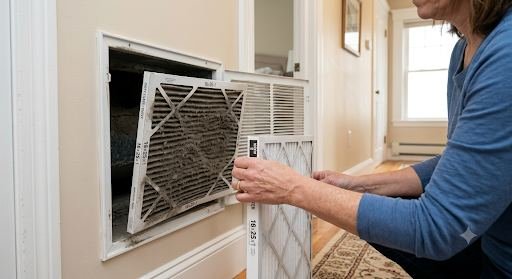
A clogged air filter restricts airflow across the evaporator coil, which is one of the most frequent reasons an AC runs constantly without actually cooling the house. If you can't remember the last time it was replaced, that's usually the answer on its own. Most residential filters need replacing every one to three months, more often with pets or heavy use.
Look for Ice on the Indoor Unit or Refrigerant Lines
Visible ice means the evaporator coil has frozen — almost always from restricted airflow, whether that's a dirty filter, closed vents throughout the house, or a failing blower motor. If you see ice, turn the system off entirely and switch the fan to "on" by itself so the coil can thaw naturally. Don't chip at the ice, and don't keep running the compressor against a frozen coil — that's exactly how a simple filter problem turns into an expensive compressor problem.
Check the Outdoor Condenser Unit
The condenser unit outside needs clear airflow on all sides. Leaves, grass clippings, mulch, or anything piled against it restricts heat exchange and can mimic the same symptoms as a dirty filter. A gentle hose-down of the fins, with the power off first, is a reasonable homeowner-level fix — just don't use a pressure washer, which can bend the delicate fins.
Check the Breaker and the Outdoor Disconnect Switch
AC systems typically have two power points: a breaker in the main panel and a separate disconnect switch or pull-out block right at the outdoor unit. Both need to be on. It's easy to check the breaker and assume that's the whole story, and miss that the outdoor disconnect got bumped or intentionally switched off during other yard work.
What's Left Is a Professional's Job
If the thermostat, filter, coil, outdoor unit, and power all check out and it's still not cooling, the remaining likely causes — a refrigerant leak, a failing compressor, or an internal electrical fault — genuinely require a licensed HVAC technician. Refrigerant work specifically requires EPA certification; it isn't a DIY step, and attempting it isn't just against regulations, it can damage the system further and void a manufacturer warranty.
Common Warning Signs Worth Mentioning on the Call
- Hissing sounds near the indoor or outdoor unit often point to a refrigerant leak.
- A burning smell suggests an electrical issue — worth shutting the system off at the breaker until a technician looks at it, rather than continuing to run it.
- The system is 10+ years old — worth mentioning up front, since a technician may weigh repair against replacement differently for an aging unit nearing the end of its typical service life.
What Actually Happens During a Diagnostic Visit
A technician will typically check refrigerant pressure with gauges, test electrical components like the capacitor and contactor, inspect the condenser and evaporator coils more closely than a homeowner can, and check for airflow restrictions throughout the duct system, not just at the filter. Having already ruled out the simple causes above means the visit goes faster and the diagnosis is more likely to land on the real problem the first time, rather than starting from zero.
Roughly What Each Cause Costs to Fix
Cost ranges shift by region and by exact model, but the pattern holds fairly consistently: a capacitor or contactor replacement is one of the cheaper electrical fixes, a refrigerant leak repair plus recharge costs more depending on how much refrigerant the system needs and how hard the leak is to locate, and a full compressor replacement is usually the most expensive single repair short of replacing the whole system. This is part of why mentioning your system's age on the call matters — a 12-year-old unit facing a compressor-level repair is a genuinely different conversation than a 3-year-old one.
A Seasonal Habit That Prevents Most of This
Most of what shows up in this guide — dirty filters, blocked outdoor units, coils that ice over — traces back to the same root cause: airflow that degrades gradually over a season without anyone noticing until the system can't keep up. A once-a-season check (filter, clear debris from the outdoor unit, confirm the drain line isn't clogged) catches most of it before it becomes an emergency call in the middle of a heat wave, when technicians are busiest and response times are longest.
Repair or Replace? A Quick Way to Think About It
A common rule of thumb: if the repair cost approaches roughly half the cost of full replacement, and the system is already past half its typical service life, replacement is usually the more sensible long-term move rather than repeatedly repairing an aging unit. It's not a perfect formula, but it's a reasonable gut-check before agreeing to a major repair on a system already well past its typical service life.
If the issue turns out to be electrical rather than mechanical, our HVAC circuit breaker guide covers that specific symptom in more depth.
| Symptom | Likely cause | Call a tech? |
|---|---|---|
| Thermostat set to Cool but nothing happens | Dead batteries, tripped breaker, or disconnect switch off | Only if resetting the breaker doesn't fix it |
| Air blows but isn't cold | Dirty filter, dirty outdoor coil, or low refrigerant | Yes, if cleaning the filter/coil doesn't help |
| Ice visible on the indoor unit or lines | Frozen evaporator coil, usually from restricted airflow | Yes — turn it off and call |
This guide covers the checks a homeowner can safely do — it can't diagnose an electrical fault, confirm a refrigerant leak, or tell you whether your specific compressor has failed. Those require a licensed HVAC technician with the right equipment, not a longer article.
Frequently Asked Questions
Why is my AC running but not cooling?
Most often a dirty air filter restricting airflow, a thermostat set incorrectly, or a frozen evaporator coil. Less often, a refrigerant leak or a failing compressor.
Is it safe to keep running my AC if it's not cooling?
If you see ice on the coil or lines, turn the system off and run just the fan. Continuing to run the compressor against a frozen coil can turn a filter problem into a compressor problem.
How much does it cost to fix an AC that's not cooling?
It depends heavily on the cause — a filter or breaker fix costs very little, while a refrigerant leak or compressor failure costs considerably more. Our HVAC repair cost guide breaks this down further.
Can I recharge my own refrigerant?
No — refrigerant handling requires EPA certification and specialized equipment. This is one of the clearest DIY-vs-pro lines in HVAC repair.
What's the difference between the breaker and the outdoor disconnect switch?
The breaker is in your home's main electrical panel; the disconnect switch is a separate power point right at the outdoor condenser unit. Both need to be on — checking only one is a common reason people miss an easy fix.
How often should I replace my air filter?
Every one to three months in most homes, more often with pets or heavy seasonal use. A dirty filter is the single most common cause of an AC that runs but doesn't cool.