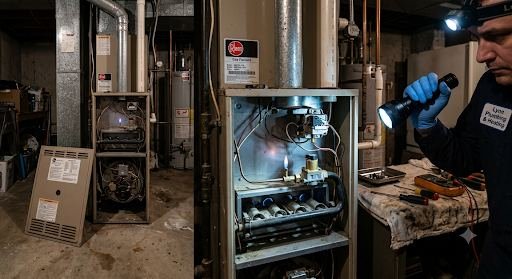
Furnace Won't Turn On: Troubleshooting Before the Emergency Call
Quick Facts
- Smell gas?
- Leave immediately, call your gas utility — skip everything else
- First step
- Confirm thermostat is set to Heat
- Common overlooked cause
- Furnace's own power switch, flipped by accident
- Can you DIY it?
- The basic checks, yes — ignition and control board issues, no
A furnace that won't turn on feels like an emergency the moment you notice a cold house, but a real share of the time the cause is something simple — a thermostat setting, a flipped switch, a tripped breaker. Work through these checks in order before calling for an emergency visit.
One Exception First: If You Smell Gas
If there's a rotten-egg smell anywhere near the furnace, skip every step below. Leave the house, don't flip any switches on the way out, and call your gas utility or 911 from outside. This is the one furnace symptom that isn't a troubleshooting situation, and no amount of homeowner-level checking is worth the risk.
How a Furnace Actually Starts Up
Understanding the sequence helps make sense of where things go wrong: the thermostat signals a call for heat, the furnace's control board checks that airflow and safety switches are satisfied, then ignition happens — either an electronic igniter or, on older units, a standing pilot light — and finally the blower pushes warm air through the ducts. A failure at any step stops the whole sequence, which is why "won't turn on" can mean several very different things depending on where in that chain it's actually failing.
Check the Thermostat
Confirm it's set to "Heat," not "Cool" or "Off," and that the target temperature is actually higher than the current room temperature. If it's battery-powered, try fresh batteries — a thermostat that looks fully powered on can still be too weak to signal the furnace reliably, especially in an older unit.
Check the Furnace's Own Power Switch
Furnaces have their own on/off switch, usually mounted on the side of the unit or on a nearby wall — it looks almost exactly like a household light switch, which is exactly why it gets flipped off by accident during nearby cleaning, storage, or other work. Confirm it's actually on before assuming anything more complicated is wrong.
Check the Circuit Breaker
Find the breaker for the furnace and reset it: switch off, wait about 30 seconds, switch back on. If it trips again immediately, stop — a breaker that won't hold indicates an electrical fault, not something to keep resetting, and it's time to call a technician rather than keep trying.
Check the Air Filter
A severely clogged filter can restrict airflow enough to trip a safety switch that shuts the whole system down before it overheats internally. If you can't remember the last filter change, replace it and try again — this single step resolves more furnace calls than most homeowners expect.
Older Gas Furnaces: Check the Pilot Light
If your furnace is an older model with a standing pilot light rather than electronic ignition, confirm it hasn't gone out. Relighting one is usually described on a label inside the furnace's access panel — if there's no label, or you're not fully confident doing it, this is a reasonable place to stop and call rather than guess at a gas appliance.
What's Left Is a Professional's Job
If you've gone through all of the above and the furnace still won't start, the remaining likely causes — an electronic ignitor failure, a dirty flame sensor, a cracked heat exchanger, or a control board fault — need a technician with actual diagnostic equipment. None of these are reasonable DIY territory, and a furnace with a cracked heat exchanger specifically shouldn't keep running at all until it's inspected, since that specific failure can allow combustion gases into the home's air.
What to Expect From a Diagnostic Visit
A technician will typically test the thermostat's actual signal to the furnace, check the control board for stored fault codes, inspect the flame sensor and igniter directly, and verify gas pressure and combustion. Having already ruled out the thermostat, power switch, breaker, and filter means the visit can go straight to the components you genuinely can't check yourself, rather than repeating steps you've already covered.
Why Older and Newer Furnaces Fail Differently
A furnace with a standing pilot light fails in fairly predictable ways — the pilot goes out, or the thermocouple that senses the pilot flame wears out and shuts off gas flow as a safety measure even though the pilot is still lit. A newer furnace with electronic ignition and a control board tends to fail in less visually obvious ways — a dirty flame sensor, a bad ignitor, or a stored fault code that only a technician's tools can read. This is part of why "it just won't turn on" can mean genuinely different things depending on the age of the unit, and why a symptom that was a simple homeowner fix on an old furnace might need a technician on a newer one.
What a Frequent Short-Cycling Furnace Is Telling You
If the furnace starts, runs briefly, then shuts off and repeats this cycle rather than simply refusing to start at all, that's a different symptom worth mentioning separately on the call — it often points to a restricted airflow issue triggering a safety shutoff repeatedly, or a flame sensor that's dirty enough to intermittently fail rather than fail completely. It's a related problem to "won't turn on" but not quite the same one, and describing it accurately helps a technician arrive with the right expectation.
If the issue turns out to be no heat at all during an active cold snap rather than a furnace that simply won't start, our no heat in winter guide covers how to judge urgency and what to do while you wait for a technician.
| Symptom | Likely cause | Call a tech? |
|---|---|---|
| Nothing happens at all | Thermostat setting, furnace power switch, or tripped breaker | Only if the breaker trips again immediately |
| Breaker trips repeatedly | Electrical fault | Yes — stop resetting it and call |
| Runs but shuts off quickly | Dirty filter restricting airflow, or overheating safety switch | Yes, if a filter change doesn't resolve it |
| Rotten-egg smell | Possible gas leak | Leave the house immediately, call your gas utility |
This guide covers the checks that are genuinely safe for a homeowner to do — it can't diagnose an ignition failure, a control board fault, or a cracked heat exchanger, and it isn't a substitute for leaving the house immediately if you smell gas. Those situations need a professional or emergency responder, not a longer article.
Frequently Asked Questions
Why does my furnace's power switch look like a light switch?
It genuinely is a simple toggle switch, usually mounted on the furnace itself or a nearby wall — which is exactly why it sometimes gets flipped off by accident during nearby cleaning or storage.
Is it safe to keep resetting a breaker that keeps tripping?
No. A breaker that trips again immediately after resetting indicates an electrical fault, not a fluke — stop resetting it and call a technician.
What should I do if I smell gas near my furnace?
Leave the house immediately without flipping any switches on your way out, and call your gas utility or 911 from outside. This is not a troubleshooting situation.
How do I know if my furnace has a standing pilot light or electronic ignition?
Older furnaces typically have a small visible flame behind a viewing window; newer ones use electronic ignition with no visible flame during standby. Check your owner's manual if you're unsure.
Why would a cracked heat exchanger be dangerous?
A cracked heat exchanger can allow combustion byproducts, including carbon monoxide, into the air the furnace circulates through your home — which is why a furnace suspected of this shouldn't keep running until a technician inspects it.
How much does emergency furnace repair cost?
It depends heavily on the cause — a simple reset or filter change costs nothing, while an ignitor, control board, or heat exchanger repair costs considerably more. See our HVAC repair cost guide for a fuller breakdown.