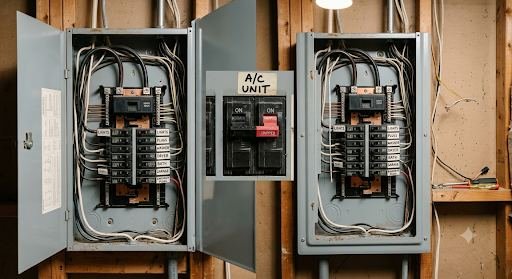
Circuit Breaker Keeps Tripping for the AC/Furnace
Quick Facts
- One trip, held after reset?
- Likely a passing surge — monitor, no action needed
- Trips again immediately?
- Real issue — stop resetting, call a professional
- Typical breaker replacement
- $150–$300
- Typical blower motor replacement
- Around $550
If your HVAC breaker tripped once and stayed on after resetting, it was likely a passing power surge or grid fluctuation — keep an eye on it, but there's no need to panic. If it trips again, especially right when the system starts or shortly after, that's a different situation, and circuit breakers are safety devices specifically designed to trip before a real electrical problem turns into a fire. Don't keep resetting it hoping it'll eventually hold.
The Timing Tells You Something
A breaker that trips the instant the system starts up points toward a startup surge issue — often a failing capacitor or motor drawing too much current in that first moment. A breaker that holds for a while and then trips as the system runs longer points more toward an overload developing under sustained load, like a dirty filter forcing the blower to work harder than it should over time.
Check the Air Filter First
A severely clogged filter restricts airflow enough to make the blower motor work harder and draw more current than normal, which is one of the simplest and most common causes of a legitimate overload trip. If you can't remember the last filter change, this is worth checking before anything else.
Check for a Shared Circuit
HVAC systems ideally have a dedicated circuit. In some older homes, they don't, and running another high-draw device, a space heater, hair dryer, or power tool, on the same circuit while the system runs can push total draw past what the breaker allows. Unplugging other devices on the same circuit and testing again helps confirm or rule this out.
What a Technician Checks Beyond That
A failing blower motor or capacitor drawing excess current, loose or corroded electrical connections that generate heat and resistance, aging or damaged wiring (sometimes from rodent damage), and an aging breaker itself becoming oversensitive after years of service are all common findings. None of these are reasonable for a homeowner to diagnose or repair directly — this is exactly the kind of electrical work where a wrong guess carries real risk.
Warning Signs That Mean Stop and Call Immediately
Warm or discolored areas around the disconnect switch or panel, any burning smell near the unit, or visibly frayed or damaged wiring are all signs of active overheating and should prompt an immediate call rather than further troubleshooting or repeated resets.
Ruling the Furnace In or Out as the Actual Cause
Before assuming the HVAC system is definitely the culprit, unplug or disconnect other devices sharing the same circuit and see if the breaker holds during a normal cycle. If your panel has multiple breakers dedicated to different parts of a 240V system, testing each independently helps pinpoint exactly which one is actually tripping rather than assuming it's the whole HVAC system at fault.
Typical Costs
A straightforward breaker replacement often runs in the range of $150 to $300. A blower motor replacement, if that turns out to be the actual cause, runs higher, often around $550 including installation. Costs vary by system and region, but this gives a rough sense of what's at stake between the simple and less-simple explanations.
The One Rule Worth Repeating
If resetting doesn't hold, or the breaker trips again on a subsequent attempt, stop resetting it and call a licensed technician or electrician. Every additional reset attempt on a genuinely faulty circuit is a small additional risk for no real benefit — the breaker tripping is it doing its job, not malfunctioning.
| Pattern | Likely cause | Call a pro? |
|---|---|---|
| Trips once, holds after reset | Passing power surge | No — just monitor |
| Trips at startup specifically | Failing capacitor or motor surge | Yes |
| Trips after running a while | Dirty filter, overload from restricted airflow | Check filter first, then call if unresolved |
| Trips repeatedly, any pattern | Wiring fault, aging breaker, or component failure | Yes — stop resetting it |
This guide can help you describe the pattern accurately on the call, but it can't safely diagnose wiring faults or component failures from a description alone — that requires a technician or electrician physically testing the circuit, not a guess based on symptoms.
Frequently Asked Questions
Is it dangerous to keep resetting a breaker that trips?
Yes, if it trips again quickly — that indicates a real electrical fault, and repeated resetting doesn't fix the underlying problem, it just repeats the risk.
Can a dirty air filter really trip a breaker?
Yes — restricted airflow makes the blower motor work harder and draw more current, which can be enough to trip a breaker under sustained operation.
Should my HVAC system be on its own dedicated circuit?
Ideally yes. Some older homes share the circuit with other outlets, and running high-draw devices on the same circuit while the system operates can cause overload trips.
What does it mean if the breaker trips right when the system starts?
This pattern points toward a startup surge issue, often a failing capacitor or motor, rather than an ongoing overload — worth mentioning specifically when you call for service.
How much does it cost to fix a tripping HVAC breaker?
It depends on the cause — a straightforward breaker replacement often runs $150–$300, while a failing blower motor replacement runs higher, often around $550.