Thermostat Blank or Unresponsive: Quick Checks First
Quick Facts
- Is this an emergency?
- No — but worth checking promptly in extreme weather
- Most common cause
- Dead or weak batteries
- Often-missed cause
- Tripped condensate float safety switch
- Can you DIY it?
- Yes for most causes — wiring/control board issues need a pro
A thermostat with a blank or unresponsive screen can feel like your whole HVAC system just died, but in most cases the thermostat itself is fine — something upstream of it lost power or tripped a safety switch. Working through the common causes in order resolves this more often than it seems like it should.
Check the Batteries First
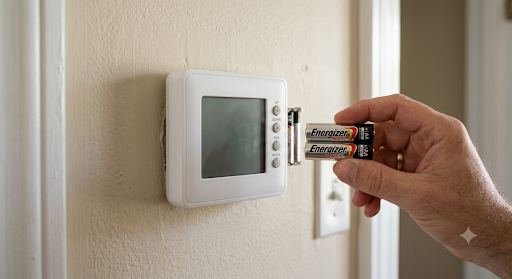
If your thermostat is battery-powered (or has battery backup even when hardwired), dead or weak batteries are the single most common cause of a blank screen. Replace them with fresh ones of the correct type — usually AA, AAA, or 3-volt lithium depending on the model — and press a button to wake the display.
Check the Circuit Breaker
Find the breaker labeled for your HVAC system or furnace and confirm it hasn't tripped. If it has, reset it: off, a brief pause, then back on. If it trips again immediately, stop resetting it — that's an electrical fault, not something to keep cycling.
Check for a Tripped Safety Switch
Many systems have a float switch near the indoor unit's condensate drain pan that cuts power to the thermostat if it detects a clogged drain backing up water — a safety feature to prevent water damage, not a malfunction. Check near the drain pan for a small switch that may have been triggered, and clear the condensate line if that's the cause.
Check That the Furnace or Air Handler Door Is Fully Closed
Many furnaces have a door safety switch that cuts power if the access panel isn't fully seated — sometimes triggered by a panel that looks closed but isn't quite latched. This is worth checking specifically after any recent filter change or maintenance that involved opening the panel.
Check for a Blown Low-Voltage Fuse
Thermostats run on low-voltage power from a transformer, protected by a small fuse, often located on the furnace or air handler's control board. A blown fuse cuts power to the thermostat specifically while leaving the rest of the system's wiring intact. Replacing it requires matching the exact fuse rating — not something to guess at.
Smart Thermostats: Try a Reset
If you have a smart thermostat and the batteries and breaker check out fine, a frozen software state can look identical to a hardware failure. Powering it off for a few minutes, or performing a manufacturer-specified reset, resolves a real share of these without needing any parts replaced at all.
Hardwired vs. Battery-Only Systems
A thermostat with a C-wire (common wire) draws steady low-voltage power directly from your HVAC system rather than relying solely on batteries, which is why some hardwired thermostats still keep basic functions going even with dead batteries in a backup slot. If your thermostat lacks a C-wire, it depends entirely on batteries, and a blank screen is more likely to trace straight back to those. Knowing which setup you have narrows down where to look first.
What a Technician Checks That You Can't
Beyond the checks above, a technician can test actual voltage at the thermostat wiring with a multimeter to confirm whether low-voltage power is reaching it at all, inspect the transformer that supplies that power, and check for a control board fault that wouldn't be visible from outside the unit. This matters because a thermostat that looks completely dead from wiring or transformer failure can be mistaken for a thermostat that simply needs replacing, when the actual fix is elsewhere in the system.
When It's Time to Call a Professional
If the screen stays blank after checking batteries, breaker, safety switches, and the furnace door, the likely remaining causes are damaged wiring, a failed control board, or a thermostat that's reached the end of its service life — typically around 10 years for most digital models. Frayed, burnt, or visibly damaged wiring specifically should not be handled without a professional, given the electrical risk involved.
Sources: Logan Services, One Hour Heating & Air Conditioning.
| Check | What it catches | Difficulty |
|---|---|---|
| Battery replacement | Dead/weak batteries — most common cause | Easy, DIY |
| Circuit breaker | Tripped breaker cutting power | Easy, DIY |
| Condensate float switch | Safety shutoff from a clogged drain line | Easy to check, DIY |
| Furnace access panel | Door safety switch not fully engaged | Easy, DIY |
| Low-voltage fuse / wiring | Blown fuse or damaged wiring | Call a professional |
This guide covers the checks that are genuinely safe and simple for a homeowner — it can't tell you whether internal wiring is damaged or whether your specific thermostat model has reached end of life. If every simple check comes back clean, that's the signal to stop troubleshooting and call.
Frequently Asked Questions
Why would my thermostat go blank after I changed my air filter?
If the furnace access panel wasn't fully re-seated afterward, a door safety switch can cut power to the thermostat — checking that the panel is securely closed is a quick, common fix.
Does a blank thermostat mean my whole HVAC system is broken?
Not necessarily — in most cases the thermostat lost power for a simple reason (batteries, breaker, a safety switch) rather than the furnace or AC itself failing.
How long do thermostats typically last?
Around 10 years for most digital models before internal components start to fail on their own, separate from any of the simpler causes covered here.
What is a condensate float switch and why does it affect my thermostat?
It's a safety switch near the indoor unit's drain pan that cuts power if it detects water backing up from a clogged condensate line — preventing water damage, at the cost of also shutting off the thermostat.
Should I try to fix a blown low-voltage fuse myself?
If you're comfortable and can match the exact fuse rating, it's a reasonable DIY step. If you're not sure, or if wiring looks damaged, it's safer to call a technician.