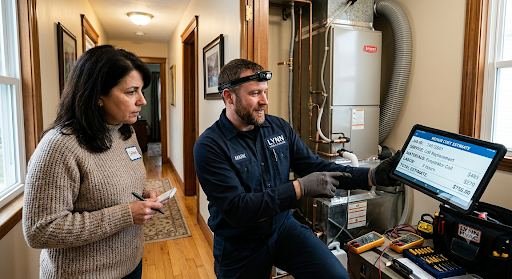
Average Emergency HVAC Repair Cost by Problem
Quick Facts
- National average repair
- Around $350 per service visit
- Cheapest common fix
- Capacitor: $120–$500
- Most expensive common repair
- Compressor: $1,000–$3,000
- Replace-vs-repair rule
- Age × repair cost over ~$5,000 favors replacement
HVAC repair costs swing widely, and the biggest single factor is which component actually failed, not the brand of your system or even necessarily its age. Understanding typical costs by problem type helps you judge whether a quote you receive is in a reasonable range.
The Overall Picture
Most HVAC repairs fall between $150 and $900, with a commonly cited national average around $350 for a single service visit and repair. The spread is wide because a service call can mean anything from a $75 drain-line flush to a $3,000+ compressor swap — the "average" number matters less than knowing where your specific problem tends to fall.
Typical Costs by Component
- Air filter / basic maintenance: $20 to $50, or $90 to $200 for a full seasonal tune-up
- Capacitor: $120 to $500 — one of the cheaper electrical fixes, though the same $15 part can cost $600 on a same-day emergency call during peak season
- Thermostat replacement: $150 to $400
- Refrigerant leak (find + repair + recharge): $300 to $1,500, varying by how much refrigerant is needed and how hard the leak is to locate
- Blower motor: $400 to $800
- Compressor replacement: $1,000 to $3,000, the single most expensive common repair short of full system replacement
The Service Call and Diagnostic Fee
Most HVAC companies charge $75 to $150 for a diagnostic visit, which may or may not be credited toward the repair cost. After-hours, weekend, or holiday emergency calls typically add $75 to $250 on top of that, or the whole job may simply run 50% to 100% higher than standard-hours pricing.
Why Timing Changes the Same Repair's Price So Much
A capacitor discovered during a routine spring tune-up might cost $150. The identical part failing on a 100-degree Saturday, when every HVAC company in town is already booked, can run $600 for the same physical repair — the part and the labor didn't get harder, but demand and urgency did. This is worth knowing specifically because it means scheduling non-emergency maintenance during shoulder seasons (spring, fall) is a real cost-saving strategy, not just a nice-to-have.
The Repair-vs-Replace Math
A commonly used rule of thumb: multiply the system's age in years by the repair cost in dollars. If the result exceeds roughly $5,000, replacement is usually the more sensible move. A $600 repair on a 12-year-old system (12 × 600 = 7,200) points toward replacement; the same $600 repair on a 3-year-old system (3 × 600 = 1,800) points toward repairing it.
Getting a Fair Quote
Ask for the diagnostic fee upfront and whether it's credited toward the repair. Request the specific component being replaced by name, not just a general description, since that lets you sanity-check the quote against typical ranges like the ones above. And for anything above a simple filter or capacitor fix, a second opinion is a reasonable ask even during an emergency — most homeowners underuse this option specifically because it feels awkward to ask for during a stressful moment, not because it's actually unreasonable to do.
What This Site Doesn't Do
Fixrn connects you directly with a local HVAC provider rather than performing the repair itself, so your actual quote always comes from that provider, not from us — these figures are a planning reference to help you evaluate a quote, not a substitute for getting one.
Sources: Modernize, HVAC Services Pro.
| Component | Typical cost | Notes |
|---|---|---|
| Air filter / tune-up | $20–$200 | Cheapest, most preventable category |
| Capacitor | $120–$500 | Same part, much higher on emergency calls |
| Thermostat | $150–$400 | Wiring/control board issues cost more than the unit itself |
| Refrigerant leak | $300–$1,500 | Varies by amount needed and leak location |
| Blower motor | $400–$800 | |
| Compressor | $1,000–$3,000 | Most expensive common single repair |
These are national planning ranges from industry cost data, not a quote for your specific system — actual pricing depends on your region, equipment brand, accessibility, and the provider you use. Get an actual estimate before committing to a major repair.
Frequently Asked Questions
Why does the same repair cost more on an emergency call?
Demand and urgency drive the price up, not the difficulty of the repair itself — a $150 capacitor fix during routine maintenance can become a $600 bill on a busy summer weekend for the identical part and labor.
Is the diagnostic fee separate from the repair cost?
Often yes, though some companies credit it toward the repair if you proceed. It's worth asking upfront, especially for after-hours calls where this fee tends to be higher.
How do I know if I should repair or replace my system?
A common rule of thumb: multiply the system's age in years by the repair cost. If that number exceeds roughly $5,000, replacement is usually the more sensible move long-term.
Why is a compressor repair so much more expensive than other components?
The compressor is the most complex and critical component in the system, requiring significant labor time (often 3 to 6 hours) plus refrigerant recovery and testing, on top of the part cost itself.
Can I avoid the higher emergency pricing?
Scheduling non-urgent maintenance during spring or fall, before peak season demand hits, is the most realistic way to get standard rather than emergency pricing for the same work.
Does Fixrn set these repair prices?
No — Fixrn connects you with a local provider; the actual quote always comes from that provider directly, not from Fixrn.